

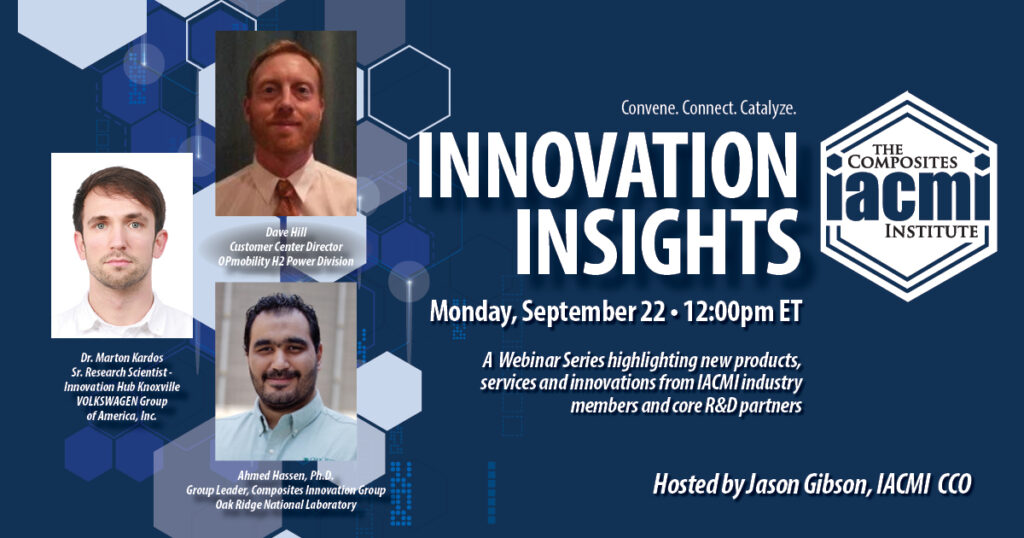
Our monthly webinar series “Innovation Insights” continued Monday, September 22, at 12:00 pm ET. IACMI CCO Jason Gibson moderated discussions with IACMI members featuring their latest news about products, services, technology, and innovations.
We will hear from:
Dave Hill
Customer Center Director
OPmobility H2 Power Division
OPmobility H2 Power Division- Leading the Charge for Hydrogen Mobility
The presentation will provide an overview of who we are at OPmobility globally and a deeper dive into our H2 Power division using composites to manufacture type IV pressure vessels for various mobility applications. Insight will be shared on the US market with regard to political and economic changes. Additionally, areas of innovation that are key to further advancing the technology to true industrial scale will be discussed – from novel material innovations to methods of recycling this high-grade carbon to maintain benefit at the end of a product’s life.
Ahmed Hassen, Ph.D.
Group Leader Composites Innovation
Oak Ridge National Laboratory (ORNL)
Reshaping Nuclear Energy Infrastructure with 3D-Printed Polymer Composite Forms
In a bold step toward transforming how nuclear infrastructure is designed and built, the Department of Energy’s Manufacturing Demonstration Facility (MDF) at Oak Ridge National Laboratory, has partnered with Kairos Power and Barnard Construction to pioneer large-scale, 3D-printed polymer composite forms for casting complex, high-precision concrete structures. These advanced forms, deployed at Kairos Power’s Oak Ridge campus for the Hermes Demonstration Reactor, reduce fabrication time from months to days and enable geometries that are impractical with conventional methods. This milestone represents a paradigm shift in nuclear energy construction, setting the foundation for future reactors and accelerating the path to reliable energy in the United States.
Dr. Marton Kardos
Sr. Research Scientist – Innovation Hub Knoxville
VOLKSWAGEN Group of America, Inc.
Paper-Based Composites
Paper pulp is a globally available material – used, collected, and recycled across regions – with well-established local supply chains. This makes it a reliable, abundant, and cost-effective resource for natural fiber composites, scalable for high-volume production. The developed composite can be tailored to specific applications and customer requirements by adjusting the type and quantity of cellulose fibers, while preform manufacturing uses established equipment and processes. These preforms can be shaped using conventional hot-pressing techniques, and additional features can be integrated through back-injection molding. The resulting components are not only functional and lightweight but also recyclable, contributing to a more sustainable product lifecycle.